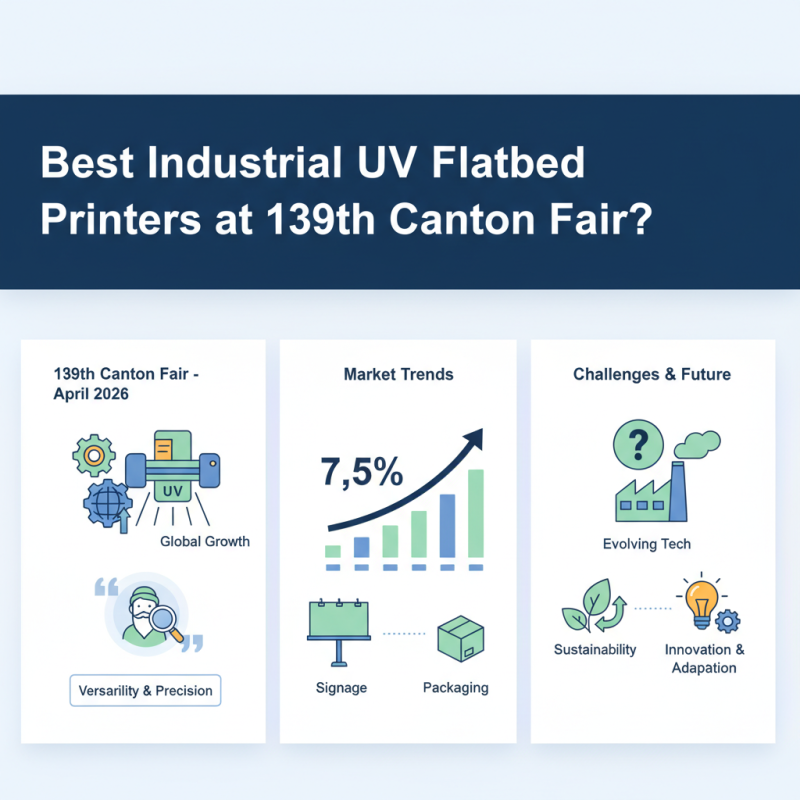
The 139th Canton Fair, scheduled for April 2026, will spotlight advanced manufacturing, including Industrial UV Flatbed Printers. These printers are revolutionizing graphics and custom printing across various industries. As noted by Dr. John Smith, a leading expert in industrial printing technology, "The future of printing relies heavily on the versatility and precision of UV technology."
Data from recent market reports reveals significant growth in the Industrial UV Flatbed Printers sector. Analysts predict a compound annual growth rate of 7.5% over the next five years. This growth showcases the increasing demand for high-quality, efficient printing solutions. With applications ranging from signage to packaging, the potential is immense.
However, challenges remain. Many manufacturers struggle to keep pace with rapidly evolving technology. The push for sustainability adds pressure to reduce waste and improve energy efficiency. Reflecting on current practices, industry leaders recognize the need for ongoing innovation and adaptation within the Industrial UV Flatbed Printers landscape.
UV flatbed printers play a crucial role in the printing industry. They offer versatility across a range of materials, from wood to glass. This technology allows for high-quality printing directly onto substrates. It opens the door for innovative designs and applications. Businesses are increasingly drawn to this capability.
Many operators appreciate the speed of UV flatbed printers. However, mastering the settings can be challenging. The initial setup often requires time and patience. Not every print job turns out perfect. Adjustments to ink settings or drying times can lead to better results. Understanding the equipment deeply can yield superior prints.
At industrial expos like the Canton Fair, advancements in UV technology are showcased. New features make printers more efficient and user-friendly. Yet, some machines still have limitations. Ink adhesion and color vibrancy can vary across materials. It’s vital for users to conduct tests. A mindful approach to these challenges can improve outcomes significantly.
Industrial UV flatbed printers have gained significant traction in recent years. Their ability to print directly on various surfaces makes them an attractive choice for businesses. This technology uses ultraviolet light to cure ink as it's printed, ensuring fast drying times and vibrant colors. According to a recent report from Smithers Pira, the global market for flatbed printers is expected to grow by 6.18% annually through 2026.
The versatility of these printers allows for creative applications across different industries. From signage to custom packaging, their adaptability is unmatched. With options for white ink and spot colors, businesses can produce striking visuals for products and displays. Notably, UV printing is also more environmentally friendly than traditional methods, as it reduces volatile organic compounds.
**Tip:** Consider the materials you'll be printing on. Some printers perform better with specific surfaces, like metals or plastics.
While UV printers are impressive, they can come with challenges. Initial costs may be high, and the technology requires skilled operators. Maintenance can be tricky, and misconceptions around speed versus quality can lead to mistakes. Choose wisely and invest time in training your staff.
**Tip:** Always evaluate ROI before purchasing. A cheaper printer might not meet your long-term needs.
In conclusion, the benefits of industrial UV flatbed printers are clear, but know your requirements to avoid costly errors.
The 139th Canton Fair showcased leading brands of industrial UV flatbed printers. This event highlighted the growing demand for advanced printing technology in various sectors. A recent industry report noted a projected CAGR of 5.4% in the UV flatbed printer market between 2023 and 2030. These printers offer versatility, allowing users to print on diverse materials, including wood, glass, and metal.
Many businesses seek to enhance productivity and reduce costs. However, selecting the right printer can be overwhelming. It’s essential to evaluate features based on your specific needs. For optimal performance, pay attention to resolution and ink quality. The latest models can achieve resolutions up to 1200 dpi, producing stunning images.
Tips: Always consult industry reviews before making a purchase. You might find models that provide greater value for your needs. Consider future proofing your investment by choosing printers that support upgrades. Regular maintenance is crucial; neglecting it can lead to lower print quality. Remember, while price is critical, quality and after-sales service are equally important.
| Model | Printing Area (mm) | Max Thickness (mm) | Print Resolution (DPI) | Speed (sqm/hr) | Technology |
|---|---|---|---|---|---|
| Model A | 1300 x 2500 | 50 | 1200 | 35 | UV LED |
| Model B | 2500 x 3200 | 70 | 1440 | 28 | Piezo Electric |
| Model C | 2000 x 3000 | 60 | 720 | 30 | UV CMYK |
| Model D | 1400 x 2200 | 40 | 1080 | 25 | Hybrid UV |
The 139th Canton Fair showcased significant advancements in UV flatbed printing technology. These innovations are revolutionizing various industries. UV flatbed printers now offer enhanced versatility, allowing users to print on diverse materials like wood, glass, and metal. According to a recent report by Smithers Pira, the market for UV printing is projected to grow at a CAGR of 8.5% through 2027.
New features in UV technology include faster curing times and higher resolution outputs. For instance, many printers now achieve speeds of up to 50 square meters per hour. This improved efficiency can lead to increased productivity and reduced operational costs. However, some manufacturers faced challenges in balancing speed and quality. The risk of sacrificing image detail for faster prints remains a concern.
Environmental aspects also emerged at the event. UV inks are generally less harmful than traditional solvents. Still, the long-term impact of these inks on recyclability is under scrutiny. Industry experts urge manufacturers to develop sustainable solutions while maintaining performance. The quest for greener technologies is ongoing in this sector.
The market for UV flatbed printers is evolving rapidly. Many businesses are shifting towards this technology. These printers offer versatility in materials. They can print on glass, metal, wood, and more. This capability attracts a diverse range of industries. The demand is growing, but some challenges remain.
One significant trend is the increasing push for eco-friendly solutions. Many companies are prioritizing sustainability. They seek printers that use less energy and produce minimal waste. However, not all UV inks meet these standards. There's still work to be done in finding greener options.
As technology advances, cost remains a concern. Some printers are expensive to purchase and maintain. Companies may hesitate to invest without guaranteed returns. Additionally, the learning curve can be steep. Training staff effectively is crucial but often overlooked. Addressing these issues is vital for growth in the UV flatbed printing market.
: They print directly on various surfaces, used for signage, custom packaging, and more.
They use ultraviolet light to cure ink instantly, resulting in fast drying and vibrant colors.
It’s versatile and environmentally friendly, reducing volatile organic compounds compared to traditional methods.
They can print on wood, glass, metal, plastics, and other surfaces effectively.
Evaluate the materials you print on and assess the long-term return on investment to avoid future issues.
Yes, initial costs can be high, and skilled operators are needed to manage maintenance and quality.
Many can achieve speeds of up to 50 square meters per hour, but speed can impact quality.
There’s an increasing demand for eco-friendly solutions but also challenges in maintenance and costs remain.
Yes, while less harmful than solvents, the recyclability of UV inks is still under scrutiny.
Absolutely, effective training is often overlooked but essential for maximizing printer capabilities.
The article explores the significance of Industrial UV Flatbed Printers within the printing industry, offering a comprehensive overview of their capabilities and advantages. These printers are renowned for their versatility, allowing for high-quality printing on a variety of substrates, making them ideal for diverse applications. Key features such as quick drying times, vibrant colors, and eco-friendly ink options are highlighted as major benefits that contribute to their increasing adoption in various sectors.
Furthermore, the article discusses the latest innovations in UV flatbed printing technology, showcasing advancements that enhance efficiency and print quality. It also examines current market trends and future prospects, indicating a growing demand for Industrial UV Flatbed Printers as businesses continue to seek sustainable and flexible printing solutions. This positions them at the forefront of the printing industry, especially in dynamic environments like the Canton Fair, where the latest advancements and technologies converge.

Colvanta Print